Showing posts with label Cognex. Show all posts

Saturday, May 23, 2015

New software naming convention?


I don’t think anyone would argue that Cognex’s PatMax tool is both powerful and capable. When you need to locate a part in an image and your regular fixturing isn’t reliable or becomes too complex PatMax will probably do it.

But, (there’s always a “but” in this blog,) it is computationally intense. Matching contours takes a lot of digital horsepower, which results in extended processing time, especially when running PatMax on a high-res InSight smart camera. So I sat up and paid attention when I spotted a recent Cognex press release.

New Cognex Feature Location Technology Offers Unmatched Performance and Speed” (May 5th, 2015) announces “PatMax RedLine™, a feature-location technology that reinvents the industry-leading PatMax® pattern-matching tool by maximizing speed and performance.” What this does, or so Cognex claim, is speed up the way PatMax runs on a 5Mp InSight.

I’m sure that’s a good thing, and I suspect, although it’s not mentioned in the release, that Cognex charge a premium for its use. However, it does beg two questions:

  1. Why didn’t my local Cognex sales rep let me know this was coming?
  2. ‘Redline’ sounds like a subway system, (Boston? San Francisco?) in which case I wonder if we should brace ourselves for ‘District’, “Piccadilly’, and ‘Bakerloo’?

Well if Google can use weird naming conventions for Android releases, what’s stopping Cognex from doing the same?

Saturday, February 15, 2014

Digesting 2013 results from Cognex


On Feb 13th Cognex released some impressive full-year results, so why did the stock price dive 9% on the 14th?

I have a theory, but explaining it requires a quick look at the reported numbers:

For the full year, revenue grew 9%, to $354m, and income increased 8% to $73m.

Good numbers to be sure, but those of you who grasp the difference between fixed and variable costs might wonder why income grew less than revenue. Shouldn’t it have been the reverse?

The answer, in my humble opinion lies in the RD&E and SG&A percentages.

Taking RD&E (Research, Development and Engineering,) first, spend jumped 17% from Q4 ’12 to the same period in ’13. If you follow the job listings on LinkedIn this will not have been a surprise: it’s clear that Cognex has been growing their engineering strength for some months. This is clearly A Good Thing and hopefully will lead to some new products in 2014.

The 18% increase in SG&A (Sales, general and Administration,) I find a little harder to swallow. Apparently some of this resulted in higher commissions. Really? Aren’t commissions just a straight percentage of selling price? Why should they rise faster than revenue? And let’s not forget that Cognex sells mostly through distributors rather than having their own sales force, like say Keyence. Leaving aside the fact that this strategy is killing them in the Vision, as opposed to ID reader, market, why should costs rise with revenue?

Okay, so that point has me baffled, but why should the stock price drop?

Well here’s my theory: stock prices are driven by expectations of future growth. These are reflected in the price to earnings ratio, which at 46 is still sky-high, so it’s not like people are giving up on the company. Clearly though, more investors decided to sell than to buy.

There were some patches of bad news in the results. Surface inspection, Japan, and semiconductors are all struggling even though there’s lots of growth coming from ID readers. More interesting though was Dr. Shillman’s comment during the investor conference call. (You can find a transcript at www.seekingalpha.com.)

Dr. Bob said Cognex was going to stop talking about future product activities because they were giving away too much information to competitors.

Isn’t that interesting? R&D spend up, concern about competitors. This suggests the winds of change are blowing through Natick. Competitors are bringing some heat and Cognex have decided it’s time to up their game.

Good for them. I’m looking forward to learning about some great new products!

Thursday, January 30, 2014

Cognex staying above the fray?


Check out the list of Exhibitors at this year’s “The Vision Show”. All the big names are there, except one.

Know which one I’m talking about? Yes that’s right, yet again old “Big Yella” has decided to stay away.

I’m not sure this is a wise move. I get that trade shows are expensive and that the ROI is hard to pin down, but out of sight is most definitely out of mind.

Keyence will be there, and I expect they’ll have a big stand full of sales people eager to explain how their vision systems will solve all your problems. And with no Cognex on hand, who’s going to present a counter argument?

This attitude of “staying out of it” seems to extend to the factory floor too. The Engineers I talk to are being blitzed by Keyence sales people who won’t take “No” for an answer. Eventually they let the guy through the front door and next thing there’s Keyence vision system out in the plant.

If you’re selling machine vision the best sales tool you can have is a working system on a plant floor. Keyence are getting those installed, and I don’t see Cognex offering any resistance.

Maybe the problem is that they’re selling through distributors. Distributors have other things to sell, so why invest time and effort in complicated vision systems when you can make a faster buck from something else, like a code reader?

Staying away from trade shows is one thing, but staying out of the fight for customers is something else. I fear Cognex are losing sales and handing the industrial market to Keyence.

Sunday, January 12, 2014

Info on code verification


Yes I know this is starting to look like BarCodes4Users and not MachineVision4Users, but I am fed up with trying to educate folks about this topic. So from now on I’m going to send everyone to “Verification” on the Microscan website. You’ll find links there to a ton (or tonne for my readers in Europe) of info. Please read it.

And yes, Cognex is big in code reading too. Real big. So if you’re shopping for hardware and software you owe it to yourself to check out both.

Thursday, December 5, 2013

The perfect machine vision job for me!


Cognex is looking for a Corporate Communications Manager to work in their Natick, MA, Headquarters. The job description says, “The ideal candidate is smart, talented and funny with a creative writing style.”

Does that sound like me or what?!! And even better, I actually know a little bit about machine vision and Cognex. But wait, reading further, I spotted this line: “Bachelor’s degree in Journalism, Communications or a related field is required; Master’s Degree a plus.”

Well there's a problem. My Master's is in a technical field, not those they've listed. And here's another requirement: “Experience in comedy or sketch writing preferred.”

So Cognex are going into the stand-up business? Now that's interesting.

I would have been so good in the role, but I turned down that writing gig for Saturday Night Live. Now I'll never get to work for Cognex. :(

Sunday, December 1, 2013

Tip for upgrading smart cameras


Smart cameras like the InSight family from Cognex have been around so long that the ones we were installing ten or even fifteen years ago are obsolete. They won’t run the latest software, they’re not very fast, and sometimes they just die. But you don’t want to re-engineer the application, so what do you do?

Well you might rewrite the code or spreadsheet for the new camera, but then how do you make sure it performs the same as the old system?

A member of the Cognex SmartList discussion forum came up with a clever idea: take an image with the old camera, send it to the new camera, and have them do the processing in parallel. This way, if they both give the same result, your new system is validated. (I’m not sure if that meets FDA /Pharma standards but it’s good enough for me.)

Rick Roszkowski of Cognex explained how to make this happen with two InSights, and the whole forum erupted in applause.

Okay, I made that last bit up, but here’s the thing: it’s an excellent idea for simplifying camera upgrades (at least for Cognex products,) and second, there is a community of vision folks out there who are will to ask questions and learn from others.

It makes me feel all warm and fuzzy.

Sunday, November 24, 2013

You’re a bunch of players


Having discussed the pros and cons of vision system standardization, (“Do you play the field?” November 14th,) I conducted a poll to find out just how fickle you lot are.

The answer is, very.

Less than a third of you use only a single make or brand of vision system, and some 40% have three or more different brands. This is interesting, and perhaps a little disappointing.

To be blunt, it says to me that you buy what the salesman pushes. When the guy from Keyence shows you their latest-and-greatest, you buy it. And the same for Cognex. And Microscan. And Banner. And so on. I may be wrong on this, though I doubt it. And it’s a pity. You’re giving yourself substantial learning curves, spares, and support issues and making life more complicated than it needs to be.

Now the number of respondents was pretty small, so I may be being unfair on some of you, but really, three or more different brands? Next time you’re shopping don’t just believe the salesman, ask me instead.

Thursday, November 21, 2013

New release of In-Sight Explorer


Hold on to your hats folks, because version 4.9.0 is going to knock them off.

Okay, that might be a slight exaggeration, but reading the release notes, (you can get them here: http://www.cognex.com/Support/InSight/Software.aspx ) it seems there are some useful upgrades. Two I found particularly interesting were:
  • A Surface Flaw tool in EasyBuilder and the spreadsheet. (This sounds similar to the flaw detect tool Keyence has been touting for a few months.)
  • A Scene Correction tool, (EasyBuilder and the spreadsheet,) to compensate for uneven lighting.
Not listed in the release notes, but discussed in the SmartList forum, this release also fixes a conflict between In-Sight Explorer and AutoCAD LT14. I hadn’t realized this, but apparently, “The new AutoCAD and In-Sight cannot coexist on the same platform.” That could be an issue for many engineers packing a host of software on their laptops.

And if you do decide to upgrade, don’t overlook the camera firmware.

Tuesday, November 19, 2013

VisionPro versus Halcon – a summary


This is one of the hoary old chestnuts of the machine vision world – which is better? As with most things in life, there’s no simple answer, but let me start with a very brief introduction.

VisionPro is the highly capable PC-based vision software product from Cognex. It does more than their smart cameras can do. Halcon is another highly capable PC-based vision software product, this time from German vision software company MVTec. MVTec however do not make smart cameras or even smart camera software (so far as I know, anyway.)

If you’re in the market for vision software, and aren’t currently wedded to any particular provider, both deserve consideration. However, it is very difficult to make a side-by-side comparison. Don’t worry though because that’s already been done. No, not by me but by New Hampshire-based vision reseller, JMAK Automation.

There’s a page on their website that provides pros-and-cons for the two packages. (Halcon versus VisionPro.)

You should be aware that JMAK is a Halcon reseller, so they are not impartial. But, I found the comparison stacked up pretty well against my knowledge of the two. In other words, I think it’s pretty accurate.

Does it tell you which is better? No. As any good machine vision professional will tell you, consider what your application needs and then decide. Put another way, the answer to the question is – it depends.

Monday, November 18, 2013

Playing in the 3D space


With several 3D inspection projects under my belt, here’s something I think I’m qualified to write about: new 3D camera products from Keyence and Cognex.

Keyence emailed a few days ago to tell me about their LJ-V7000 Series 3D scanner. I couldn’t find it on their page, but I was able to look through the product brochure. Their claim to fame is that it’s fast, but what interested me more is that it appears very precise.

This precision stems from an interesting, and in my opinion very sensible, design decision. They are using a blue laser. Now that means they suffer less diffraction effects than does someone using a red laser, like say Cognex.

Cognex jumped into 3D with the DS1000 unit. Otherwise very similar to the Keyence product, this looks very easy to set up and use, though I haven’t tried it myself. It’s also not massively expensive, but perhaps that depends on what you expect.

Clearly these two 3D products have their strengths and weaknesses. I look forward to trying them both.

Monday, October 28, 2013

Third quarter results from Cognex


"Pretty good" pretty much sums up the third quarter. Revenue (sales) up 13% from the same period in 2012 and income (profit) up 16%.

The income number is especially impressive when you compare the most recent quarter with the one before. That shows an improvement of 23%.

And where does this come from?

Reading between the lines, Cognex scored a sweet deal on sales of Dataman code readers to a large logistics organization. No word on who that is, but I bet they’re beating themselves up for not having pushed Cognex for lower pricing!

In other news, I was pleased to see R&D spend up significantly, albeit in proportion to revenue. Still, at around 13% I think there’s room for improvement. And with Keyence nipping at their heels, I really think they need to do more. Perhaps they could ramp up the 3D product for instance. I’d like to see that run a whole lot faster.

The guidance for Q4 was that it also looks pretty good. I guess machine vision is doing well at the moment.

Wednesday, September 18, 2013

Advice for laser triangulation systems


Using a laser line to get height information is now so easy there are smart cameras that can do. (Check out www.Sick.com and even the Cognex DS1000 to see for yourself.) Yes despite the advances, 3D still has some challenges.

Chief among these is calibration. If you’re doing 3D you probably want height information in inches or millimeters, so how do you convert pixels to real-world units?

There’s some good advice on this in “Calibration of 2D Cameras for 3D Inspection” published in Photonics Tech Briefs, May 1st 2013. And the article also discusses lens issues to be aware of when you’re doing triangulation.

If there’s a 3D project in your future, I encourage you to read and learn.

Sunday, August 4, 2013

Advantages of machine vision in reading bar codes


Reading codes, 1D and 2D, is a large and growing machine vision application area, yet there are still those who say laser scanners are sufficient. If that’s you, or maybe you’re just on the fence, (The “why use more tech than you need,” mindset,) take a look at “Image-Based ID Boosts Read Rates” (Control Design magazine, July 9th, 2013.)

This gives a lot of detail about how the Cognex Dataman sensors do their job, but what I found more interesting was the explanation of the business benefits of higher read rates. Now if you’re at the grocery store checkout poor read rates are irritating, but in manufacturing they can be expensive, which is what the article describes. If justifying the upgrade to vision is giving you a headache, this article may offer some pointers.

And in case you think I’m plugging Cognex exclusively, let me remind you that Microscan also offers a very capable range of code reading products.

Thursday, August 1, 2013

The Cognex stock split


Around the same time the Q2 and first half results came out, Cognex also announced a two-for-one stock split.

Interesting decision. Why would they do this?

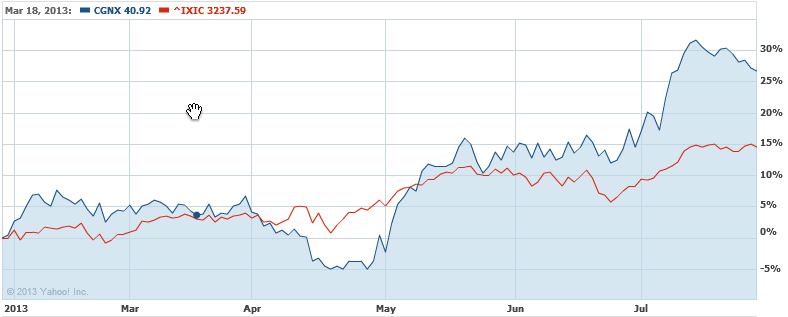
Well my reading suggests the idea is to make the stock more attractive to small investors. As such, a stock is often split after a big run up in price. And Cognex has certainly seen that recently, as this chart, lifted from Yahoo finance, confirms.


(The red line is the performance of the NSADAQ over the same last six months.)

There’s also a school of thought that says the sum of parts will be greater than the whole after a split, perhaps because the lower price makes it more attractive to small investors, or because it’s seen as a sign of confidence, or possibly both.

I do have to wonder though if there’s a link to the decision to pre-pay dividends last year. A kind of “here’s a crumb” for the investors. (Although you’d think the capital growth would put a smile on their faces.)

And then there’s the question, in my mind anyway, of what caused the run up in the stock price at the beginning of July. Did I miss some especially significant news about Cognex?

Guess I’ll just have to wonder.

Wednesday, July 31, 2013

Curious about Ethernet Powerlink?


GigE I feel I know, but Ethernet Powerlink was a new term to me, so I’ve done some digging.

It was an article in Design News called “Machine Vision Using Ethernet Powerlink” (May 30th, 2013,) that got my attention. This discussed how the Cognex 7000 series InSight has “built-in support” for Powerlink, but as the writer seemed to assume I was already familiar with this there wasn’t much in the way of explanation. So I turned to Wikipedia.

This told that Ethernet Powerlink is basically real-time Ethernet, which sounds like a good thing in machine control. (http://en.wikipedia.org/wiki/Ethernet_Powerlink if you want to read.) It also referenced the Ethernet Powerlink Standardization Group, or EPSG for short.

Their website (http://www.ethernet-powerlink.org/) provides some good info about what it is, and why you might want to use it. I haven’t digested it all yet, but I do intend to, and that’s because I have a feeling we’ll be hearing more about Powerlink.

Tuesday, July 30, 2013

Time to look at Cognex


With the half year results reported Monday evening, it’s time we took another quarterly look at the machine vision behemoth.

Eroding margins?

Dr. Bob put a positive spin on it, but I see little to celebrate when income (profit) drops while revenue (sales) grows. Surely incremental revenue gains should produce significantly larger growth in profit?

Well let’s take a look at the numbers, and then I’ll offer my perspective.

It’s my belief that the numbers for a single quarter don’t tell us much, but the half year is more informative. So, compared to the first half of 2012, Cognex grew revenue $5m to $167m, but income fell $1.6m to $32m. Okay, they’re still very profitable, but not quite as profitable as previously.

Costs are higher

Dr. Bob says this came about because of increased product development spending and expansion of the sales force. (Though by my calculations they’ve only added about $2m in cost, which works out at around a dozen machine vision hardware and software specialists.) I think we heard that at the end of the first quarter too, and while I understand you have to sow before you can reap, it would be good to see a few green shoots.

New products and markets

Besides a few references to the growth of ID readers (now 25% of revenue,) and a new retail customer using the Dataman in logistics, there’s not much in the formal report about where this will come from. But if you do like me and read the earnings conference call transcript, (available at www.SeekingAlpha.com and accessible through Yahoo Finance,) you’ll learn a little more

At that call CEO Rob Willet said he sees life sciences as a big potential market for barcode reading. And given all that’s happening in pharma with “Track and Trace,” that makes sense to me. Obviously there are regulatory hurdles to be overcome, but with that hint it doesn’t take much to see millions of “image engines” reading code sprinted on test tubes of blood and other fluids.

Also at that call, an analyst asked about the success of their 3D product. Willet replied that it’s going well with some wins in automotive, but he seemed more interested in the emerging opportunities in consumer products and especially food.

The future?

I got to know Cognex because of their capabilities in the industrial machine vision market. Increasingly though, it seems to me they’re moving away from inspection to focus on code-reading. That may well turn out to be a wise move, but I wonder if it’s also like when IBM got out of the PC business. We old-timers will look back and say “Do you remember when Cognex made vision systems?”

I guess time, and perhaps the Q3 results, will tell.

Sunday, July 28, 2013

Machine vision in traceability systems


Cognex and Microscan both talk a lot about their code reading solutions. What I’ve not seen though is much explanation of why and how you’d want to deploy this technology. Now if you’re in the pharmaceutical industry you probably know this stuff, but if not, I suggest you take a look at the “What is Pharma Track-n-Trace” on the website of Omega Design Corporation.

In particular, take a look at two of the videos linked from that page. Start with “OmegaTrack Demo at PEI 2010. Here the President of Omega takes the viewer through a packaging line, pointing out the various vision systems employed.

Two systems on that line caught my eye. The first is the LabelSync Vision Station. This uses the Cognex OmniView tool to image the full 360 of the surface of a tablet container. A fifth camera reads the datamatrix code printed on the bottom of the container and software compares it with the code on the label.

The second system is at the end of the line, and unfortunately is not discussed in any detail. Again, it’s a multi camera system checking that all the codes are correct. What intrigued me though is the container codes are read through the clear plastic packaging. If you’ve ever attempted that task you’ll know it’s decidedly non-trivial. I’d love to know what lighting they use – would polarization have a part to play?

So there you have it: machine vision, actually it’s Cognex machine vision, in a track-and-trace application. I’m just curious why I haven’t seen it in any Cognex marketing material.

Thursday, May 2, 2013

A sleeping giant wakes?


Looking at the Q1 2013 results from Cognex, it seems to me they’re starting to respond to competition from rivals. Let’s take a quick look at the numbers, and then I’ll offer my take on what’s happening.

First, comparing this latest quarter with Q1 of ’12, revenue was up 4% to almost $81m and income grew 9% to $15.6m. So it’s fair to say things are going well, but what of the long term?

Here’s where I see a couple of interesting indicators. R&D spend is up 9% compared to a year ago, and SG&A (basically, the sales force,) is up 5%. Those increases are larger than the revenue growth, and, as stated on the published results, are “to accelerate the introduction of new products.”

What new products have we seen? Well there have been a couple of DataMan code readers, which appeal to markets outside of manufacturing, like logistics and “e-tail” and there’s also a 3D laser sensor, the DS1000 series.

While the sales volumes for this will be small it’s an interesting, and late, riposte to SICK’s Ranger series of products, and perhaps also the growing strength of LMI. What I haven’t registered though is any advance in the VisionPro software platform. And with ID readers accounting for a quarter of revenue and growing fast, I suspect we won’t.

What’s Brian’s take on this? Well let’s factor in one other point: Cognex are doing well in Asia, except for Japan where, adjusting for exchange rate shifts, revenue is flat. Who lives in Japan? Why isn’t that Keyence’s home?

So, I think that while Cognex have decided to address the threat from the 3D guys, it’s really Keyence that has them concerned. Keyence is bigger and has deep pockets, and that my friends, is why Cognex are plowing more resources in to product development.

I think we machine vision users will be the beneficiaries. Especially if we buy code readers.

Sunday, April 7, 2013

Patent wars


Cognex is going after Microscan, claiming its Mobile Hawk DataMatrix codereader infringes a Cognex patent. (Yahoo Finance, April 2nd, 2013.) Unsurprisingly, Microscan asserts that Cognex’s claim is “without merit.”

One wonders what’s really going on. Could Microscan really have stolen Cognex’s ideas and put them out in the Hawk?

Seems unlikely to me. Cognex is a pretty litigious company and they like to protect their intellectual property. It looks to me more like a shot across the bows. By forcing Microscan to spend a lot of time and energy defending themselves Cognex is putting them on notice that they will not give up market share without a very expensive fight.

Can Microscan afford that fight? I suspect not, so eventually some deal will be worked out. My bet is that Cognex will agree to go away if Microscan stays off their turf.

Perhaps Microscan should be flattered that Cognex is taking them seriously!

Monday, March 18, 2013

Does the brand of vision system matter?


In “A vision system selection case study” posted back on March 10th I shared a link to a somewhat unremarkable machine vision case study. This concerned a company that had decided to go with Omron for its vision.

Now Omron make a decent vision sensor, although I wouldn’t describe them as being “leading edge” in terms of capabilities or technology. In fact without looking at the spec sheet I’d lump them in with the low end Keyence and SICK systems, possibly Cognex Checker too. In short, I didn’t give much thought as to why Omron was the “answer to a maiden’s prayer,” as some might say.

But reader David Dechow did, and he commented too. Click the link to read his whole post, but the gist of it is this: it’s unlikely there was anything so special about the task or the Omron system that meant no other system would work.

I think this is a very important point, and I tend to agree. Within a product class – say, vision sensors – there’s little to choose in terms of capabilities. Sure, some might be easier to set up than others, and some may have a steeper learning curve, but it’s my experience that with skilled implementation they can all do the job.

And it follows from this that if a task demands a higher-level set of tools – advanced pattern matching, for example, then no sensor is going to do the job and you’ll need to look at high-end smart cameras or possible go to a PC-based system.

I could probably turn this in to Brian’s Rule of Vision System Selection, which would say: define the capabilities needed for the vision task, then search among that class of products for the one that best meets your needs. Or something like that.

By the way, I’m sure most of you already know David Dechow, but if not, let me give a little shout-out to him and his company, Aptúra Machine Vision Solutions. Browse his site and you’ll see David knows his stuff.